
The Short Answer, and Where It Breaks Down
If a garage door reverses before it closes, the safety sensors are blocked, dirty, or out of alignment nine times out of ten. That's the first thing any technician checks, and it's the cheapest fix on this list. The exceptions are what make this annoying: a door that reverses only in cold weather, only halfway down, or not at all, is usually pointing at something mechanical rather than electronic — and those jobs take longer and cost more.
What You're Actually Seeing
Before you start checking parts, it helps to know which pattern you've got, because it narrows down the cause fast.
- Door reverses instantly, barely moving before it goes back up — almost always the sensors.
- Door closes partway, then reverses — often a track obstruction, bent track, or a limit switch set wrong.
- Door won't move downward at all, opener hums or clicks — check the sensors first, then the opener's travel settings.
- Door closes fine most of the year but reverses in winter — this is a cold-weather symptom tied to lubrication and metal contraction, common once overnight temps drop and the garage goes unheated.
The Causes, In the Order a Technician Checks Them
1. Photo-Eye Sensors
The two small sensors near the bottom of the tracks have to see each other in a perfectly straight line. A knock from a bike, a snow shovel leaning against one, or just a buildup of road salt film on the lens is enough to trigger a false reversal. The fix is wiping both lenses clean and checking that the indicator lights are solid, not blinking — a blinking light means they're misaligned and need to be gently repositioned until both lock on.
2. Track Obstructions and Debris
Next is a visual check of both tracks for anything blocking the rollers — a chunk of ice that's built up from melting snow dripping off the car, road salt residue that's hardened into a crust, or a rock that got kicked in. Winter in central Ohio is the worst season for this, since the freeze-thaw cycle moves debris around even when nothing looks wrong at a glance.
3. Limit Switch Settings
If the door reverses at almost the same spot every time, the opener's down-limit setting is likely off — it's telling the door it's hit the floor when it hasn't, or the reverse-sensitivity is tripping too easily. This is an adjustment made at the opener unit itself, usually with a small dial or button sequence depending on the model, and it takes a few test cycles to get right.
4. Force and Travel Calibration
Openers are supposed to reverse if they meet resistance, which is a safety feature — but if the force setting is too sensitive, normal friction from a slightly stiff door is enough to trip it. Recalibrating this means running the door through several open-close cycles while adjusting the force setting incrementally, not just cranking it up and hoping.
5. Weakening or Broken Springs
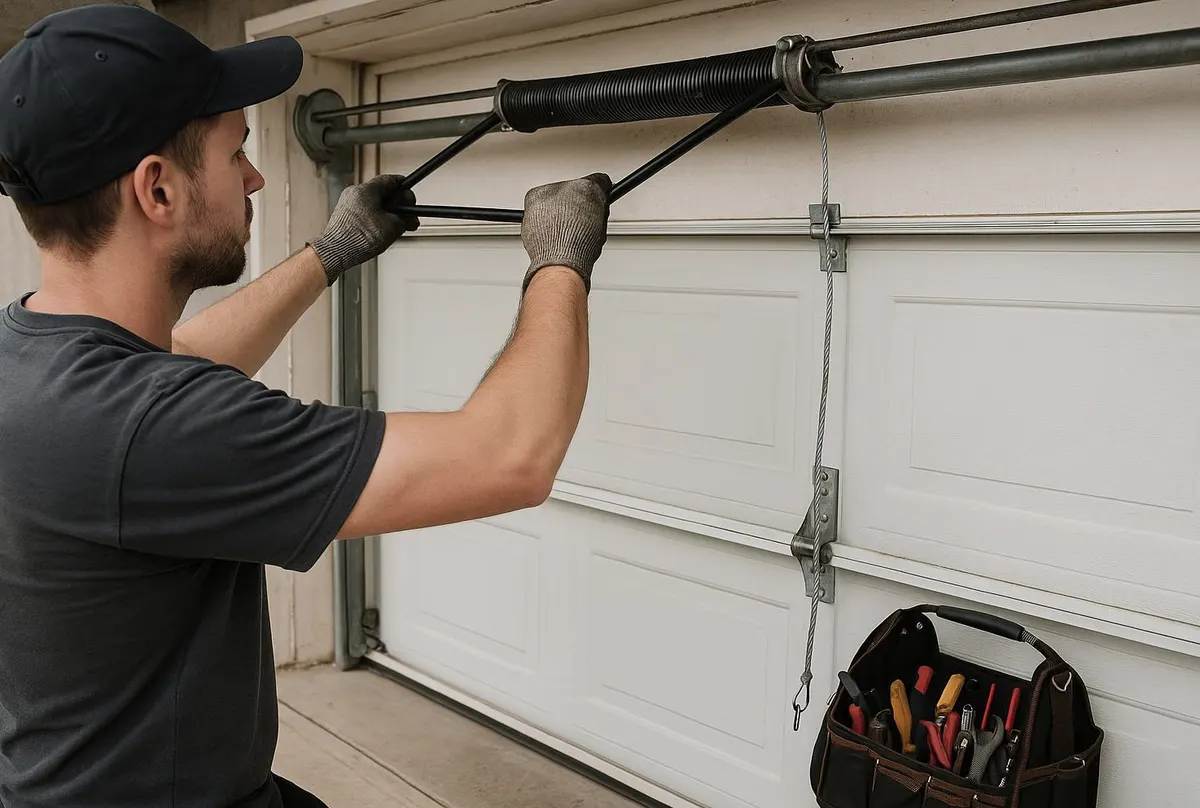
If the door hesitates, shudders, or reverses under what sounds like strain rather than a clean safety stop, the springs may be losing tension or close to failing. A door with weak springs can't carry its own weight evenly, so the opener reads that imbalance as an obstruction. Spring replacement isn't a DIY repair — the springs are under heavy tension and require the right tools to remove and reset safely.
6. Cold-Weather Stiffness
During a hard freeze, grease on rollers and hinges thickens, metal tracks contract slightly, and weatherstripping can stick to the floor overnight. None of this is a malfunction exactly, but it adds enough resistance that a door riding the edge of its force setting will start reversing until things warm up or get re-lubricated with a product rated for cold temperatures.
7. Opener Logic Board
If every sensor, track, and setting checks out clean and the door still won't cooperate, the circuit board inside the opener itself may be failing. This is usually the last thing checked because it's the least common cause, and it typically means opener repair or replacement rather than a simple adjustment.
When to Call Columbus Garage Door Pro
If you've cleaned the sensors and the door still won't close, or if it's reversing with a groaning or shuddering motion that suggests spring trouble, it's time to get a technician out rather than keep testing it yourself. Columbus Garage Door Pro handles both ends of this problem — Spring Replacement for doors that are struggling under their own weight, and Garage Door Opener Repair & Installation for limit switch, force calibration, and logic board issues. We also run Emergency Garage Door Service for anyone whose door won't close at all, which matters a lot more once overnight temps drop and an open garage means a cold house by morning.
If your garage door is giving you trouble anywhere in Columbus, OH and the surrounding area, call Columbus Garage Door Pro and we'll get it diagnosed and fixed right the first time.